Sacral Mechanics

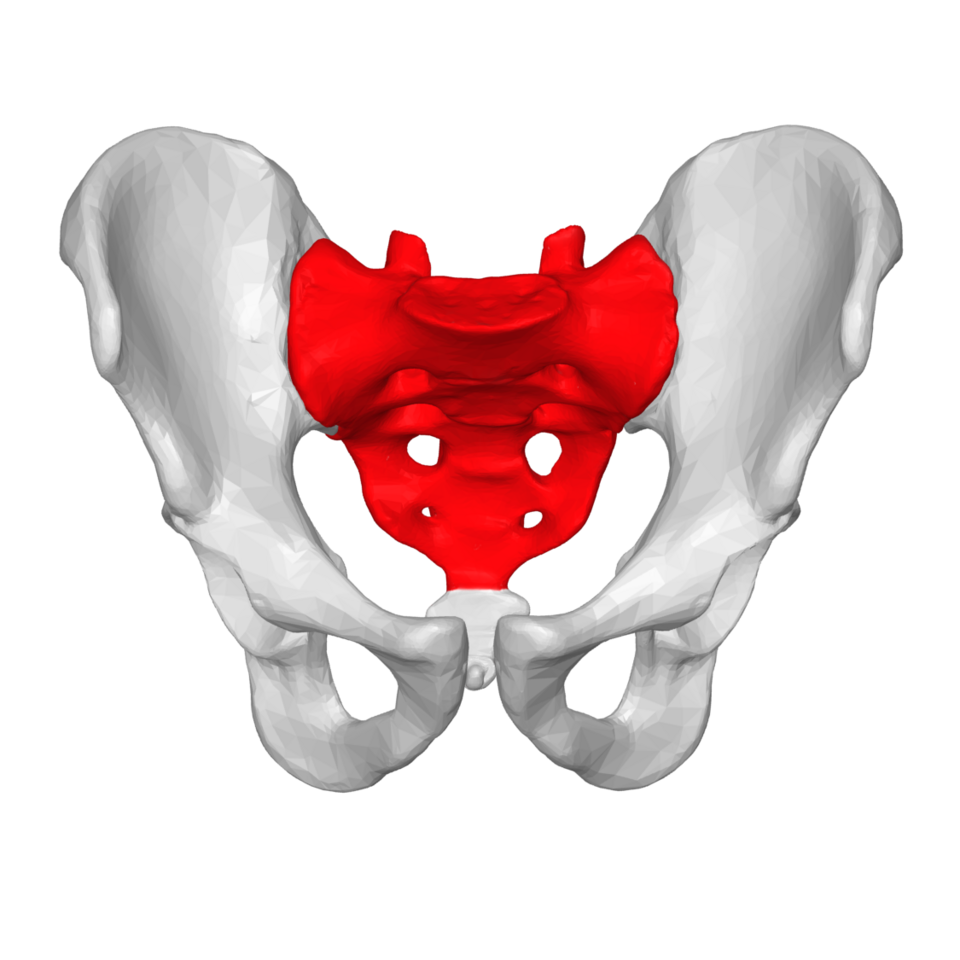

Inominate Axes
- Superior axis
- Craniosacral
- Respiratory
- Middle axis
- Postural
- Inferior axis
- Innominate
- Oblique axes
- Left/Right - Dynamic motion during ambulation
- The side of engagement of the oblique axis always aligns with the weight-bearing leg
- The left oblique axis is engaged when your left leg is on the ground (weight-bearing).
Tests
Seated flexion test
A seated flexion test is used to assess the movement of the sacrum on the ilium via the posterior superior iliac spines (PSIS) during forward flexion. The patient sits down. The examiner places their thumbs under the PSIS. The patient then bends forward at the hips, and the movement of the PSIS is assessed. The positive result indicates that one PSIS moves more superior than the other. This suggests that there is limited movement of the sacrum on the ilium (PSIS is not moving as freely) on the side where the thumb is higher.
- Left PSIS is more superior than the right -> Left +seated flexion test
- Right PSIS is more superior than the left-> Right +seated flexion test
Spring Test
A spring test is performed when the patient is lying prone. The examiner then applies a posterior-to-anterior pressure on the sacral base. If there is a lack of springing, i.e., limited movement, this indicates a posterior or extended dysfunction. If there's normal spring, this suggests an anteior or flexed dysfunction.
- Spring -> Negative -> Flexed dysfunction
- Rigid/no spring -> Positive -> Extended dysfunction
Sphinx Test
This test involves the patient lying prone and lifting themselves up on their elbows, like a child watching TV on the floor. The examiner then palpates the sacrum. If the sacral sulci (or sacral base) move forward bilaterally, this results in a negative test or flexed dysfunction. If it is unilateral or lacks symmetry, then it is a positive test, which indicates a posterior or extended dysfunction.
- Forward movement of sacral base -> Negative -> Flexed dysfunction
- No/unilateral movement of sacral base -> Positive -> Extended dysfunction
Positive sphinx and spring tests are indicative of backward sacral torsions (right-on-left or left-on-right), whereas negative sphinx and spring tests are indicative of forward sacral torsions (right-on-right or left-on-left).
Torsion
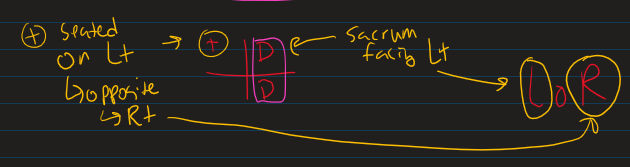
When naming torsions, the first letter refers to the direction of the sacrum, and the second letter refers to the side from which the oblique axis originates. It is important to note that the positive side of the seated flexion test is opposite to the axis. This is because the seated flexion test identifies the side where there is a restriction of movement of the sacrum on the ilium. As a result, the axis is on the opposite side (where there is no restriction of movement) in order to allow for the torsion to occur.
- LoR = Sacrum is facing left with a right oblique axis
- Left +seated flexion test
- RoL = The sacrum is facing right with a left oblique axis
- Right +seated flexion test
Some "shortcuts" to naming torsions:
If the seated flexion test, sacral sulcus, and ILA are all on the same side, the name is based on the opposite side. For example, if everything is on the left, then the torsion is on the right.
- RoR
- +left seated flexion test, deep left sulcus and ILD
- LoL
- +right seated flexion test, deep right sulcus and ILD
else:
- The first letter is which direction the sacrum is facing
- The second letter is opposite side of the seated flexion test is on
- LoR
- The sacrum is facing to the left with a left positive seated flexion test (opposite of left seated flexion test -> right)
- RoL
- The sacrum is facing to the right with a right positive seated flexion test (opposite of right seated flexion test -> left)
- LoR
Unilateral Shear
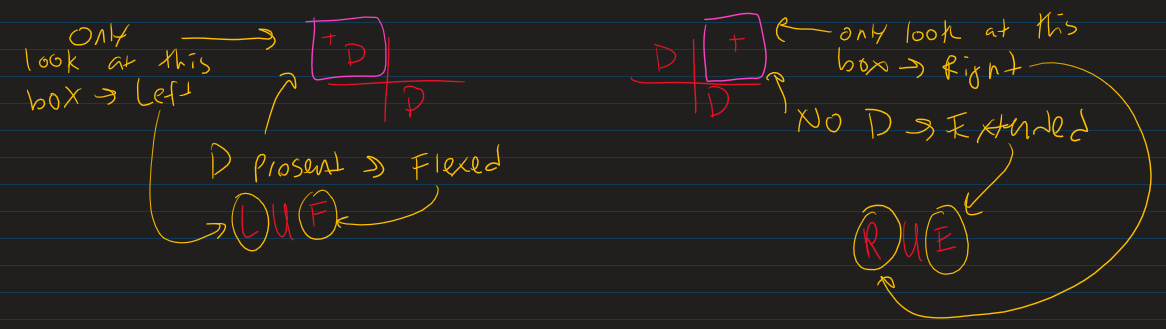
- Only look at what side the positive seated flexion test was on
- If the sulcus is deep where the +flexion test -> Flexed.
- If it is shallow -> Extended
- Example
- Left +seated flexion test with a deep sulcus on the left -> Left flexed unilateral shear
- Left+seated flexion test with a shallow sulcus on the left -> Left extended unilateral shear
Bilateral Shear
- Both the left and right sulci are deep (Both the left and right ILA are shallow)
- Bilateral flexed shear
- Both the left and right sulci are shallow (Both the left and right ILA are deep)
- Bilateral extended shear
Naming L5 based on the sacrum
- L5 - Rotate Opposite Sidebend the Same (ROSS)
- Rotates opposite of sacrum
- Sidebend the same as the sacral axis (Opposite the side of the seated flexion test)
Example:
- LoL
- L5, Rotated Right, Sidebent Left (L5NRrSl)
- Following Fryette’s Principles -> Rr and Sl = neutral
- L5, Rotated Right, Sidebent Left (L5NRrSl)
- LoR
- L5, Rotated Right, Sidebent Right (L5F/ERSr)
- Following Fryette’s Principles -> Rr and Sr = Flexed or Extended
- L5, Rotated Right, Sidebent Right (L5F/ERSr)
Treatment
- Axis side down
- RoL = Left side down
- Forwards torsion = Face to the table (Face down)
- LoL/RoR
- Backwards torsion = Back to the table (Face up)
- RoL/LoR