Somatic Dysfunctions


Impaired or altered function of related components of the somatic system: skeletal, arthrodial, myofascial structures, and related vascular, lymphatic, and neural elements.
Key Features of Somatic Dysfunction
- TART findings:
- Tenderness
- Asymmetry (anatomical or functional)
- Restriction of motion
- Tissue texture changes
Types of Somatic Dysfunction
- Acute
- Warm, moist skin
- Erythema or redness
- Boggy or edematous tissues
- Sharp tenderness
- Muscle hypertonicity/spasm
- Restricted motion with a sudden “stop”
- Chronic
- Cool, dry skin
- Pale or dusky skin tone
- Thin, fibrotic tissues
- Dull or achy tenderness
- Muscle contracture or weakness
- Mild restriction, often with gradual onset
Common Somatic Dysfunction Terms
- Fryette’s Laws (apply mostly to thoracic and lumbar spine)
- Law 1: In neutral position, sidebending and rotation occur to opposite sides (Type I)
- Law 2: In flexion/extension, sidebending and rotation occur to the same side (Type II)
- Law 3: Motion in one plane reduces motion in others
Somatic Dysfunction Patterns
- Type I (Neutral) Dysfunction
- Involves groups of vertebrae
- Neutral spine position (no significant flexion or extension)
- Sidebending and rotation occur to opposite sides
- Typically chronic or postural compensations
- Type II (Non-neutral) Dysfunction
- Involves a single vertebral segment
- Occurs in flexion or extension
- Sidebending and rotation occur to the same side
- Usually acute or traumatic
Diagnosis
- Perform a thorough motion test to identify:
- Sidebending restriction
- Rotation restriction
- Use palpation to assess:
- Tenderness
- Tissue texture changes
- Identify TART findings
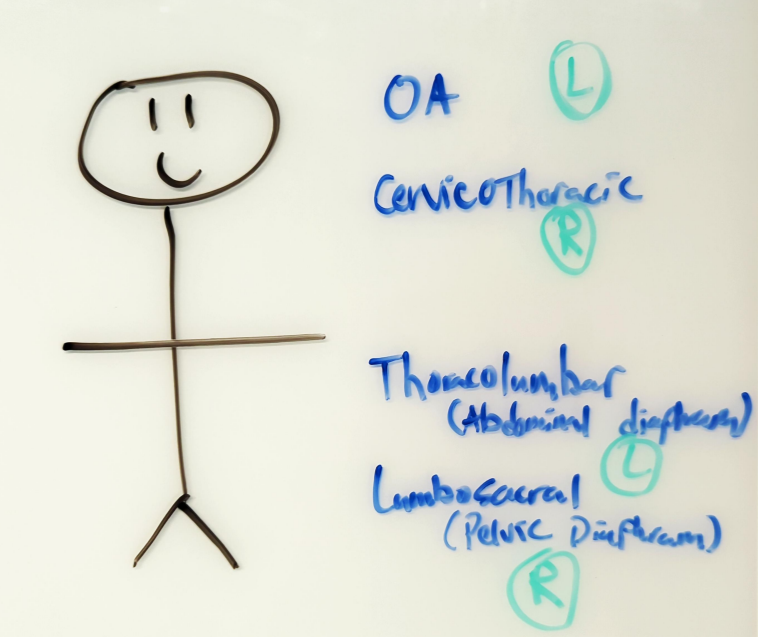
Zink Compensatory Pattern